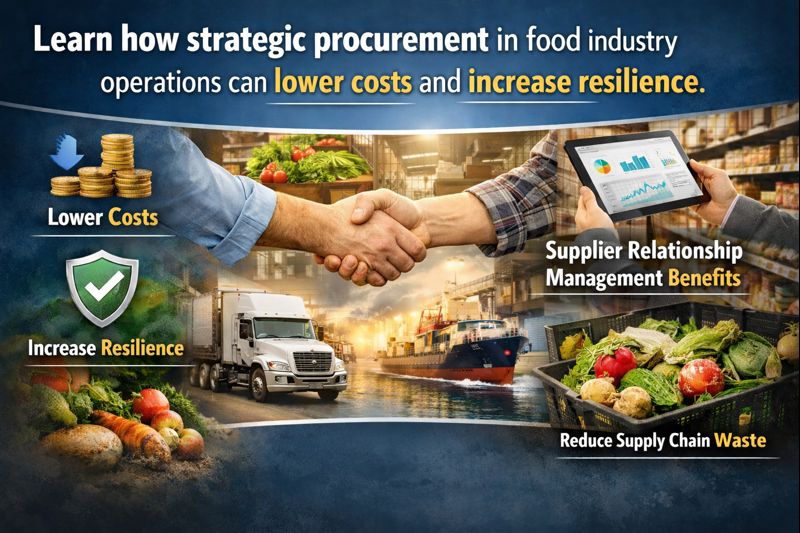
In the high-stakes world of food and beverage manufacturing, the traditional view of purchasing is rapidly evolving. It is no longer enough to simply find the lowest price for raw ingredients. To thrive in a volatile market, organizations must shift toward strategic procurement in food industry operations. This approach treats sourcing as a value-driver rather than a cost center, aligning every purchase with long-term business goals.
When you master the link between procurement and supply chain management, you don’t just save money on the front end. You build a more resilient, transparent, and profitable operation.
The Core Pillars of Strategic Procurement
Strategic procurement is a holistic process that considers the total cost of ownership. It requires a deep understanding of how raw material decisions impact the rest of the distribution cycle.
- Alignment with Supply Chain Goals: Every procurement decision should support your distribution strategy. If you source a lower-cost ingredient that requires more complex, specialized cold chain handling, the initial savings are quickly erased by increased freight costs.
- Supplier Relationship Management Benefits: Moving away from transactional relationships toward strategic partnerships allows for better collaboration. Stronger ties with suppliers lead to improved quality, prioritized service during shortages, and shared innovation in packaging or processing.
- Data-Driven Decision Making: Real-time data is the lifeblood of procurement. By understanding your inventory levels and lead times across the entire network, you can avoid the “panic buying” that leads to excess stock and high storage fees.
- Reducing Supply Chain Waste: A strategic approach identifies inefficiencies before they happen. This includes everything from optimizing order quantities to minimize spoilage to selecting suppliers that use more efficient, transport-ready packaging.
The Link Between Procurement and Distribution
The most overlooked aspect of procurement is the “last mile” of the sourcing process: how those goods get to your facility and, ultimately, to your customers. This is where many companies lose their margin.
Fragmented procurement leads to fragmented logistics. When sourcing is siloed, it results in uncoordinated shipments, underutilized trucks, and a lack of visibility that makes reducing supply chain waste nearly impossible. To solve this, procurement must be integrated with a robust logistics network.
Why The Hitch is Imperative to Your Procurement Strategy
Outsourcing to a specialized partner like The Hitch is the missing link for many procurement teams. While your team focuses on sourcing the best ingredients, The Hitch provides the infrastructure to move them smarter.
- Network Visibility: By plugging into The Hitch’s network, procurement leaders gain a clearer view of distribution lanes. This data allows for better decisions on where to source materials relative to where they will be processed and sold.
- Operational Precision: The Hitch manages the entire journey, providing comprehensive logistics services like end-to-end transportation and inventory management. This ensures that the high-quality materials your procurement team worked hard to source are handled with the food-grade care they require.
- Cost Efficiency through Consolidation: Just as strategic procurement seeks to lower the total cost of materials, The Hitch uses a shared cold chain model to lower the cost of moving them. By consolidating freight, you achieve economies of scale that are impossible to reach alone.
- Resilience and Agility: When disruptions occur, a partner like The Hitch provides the scalability to pivot. Whether you need to change routes or access additional cold storage, you have the flexibility to protect your supply chain without massive capital investment.
True success in the food industry happens when strategic procurement in food industry practices meet world-class distribution. By leveraging the expertise and network of The Hitch, you ensure that your procurement strategy delivers results all the way to the customer’s door.